Coffee Shop Par Levels: A Delivery-Day Order Worksheet
Set coffee shop par levels with an ordering worksheet covering lead time, usable stock, incoming orders and case rounding, with a worked oat milk example.
By Jared · 2026-11-14 · 8 min read
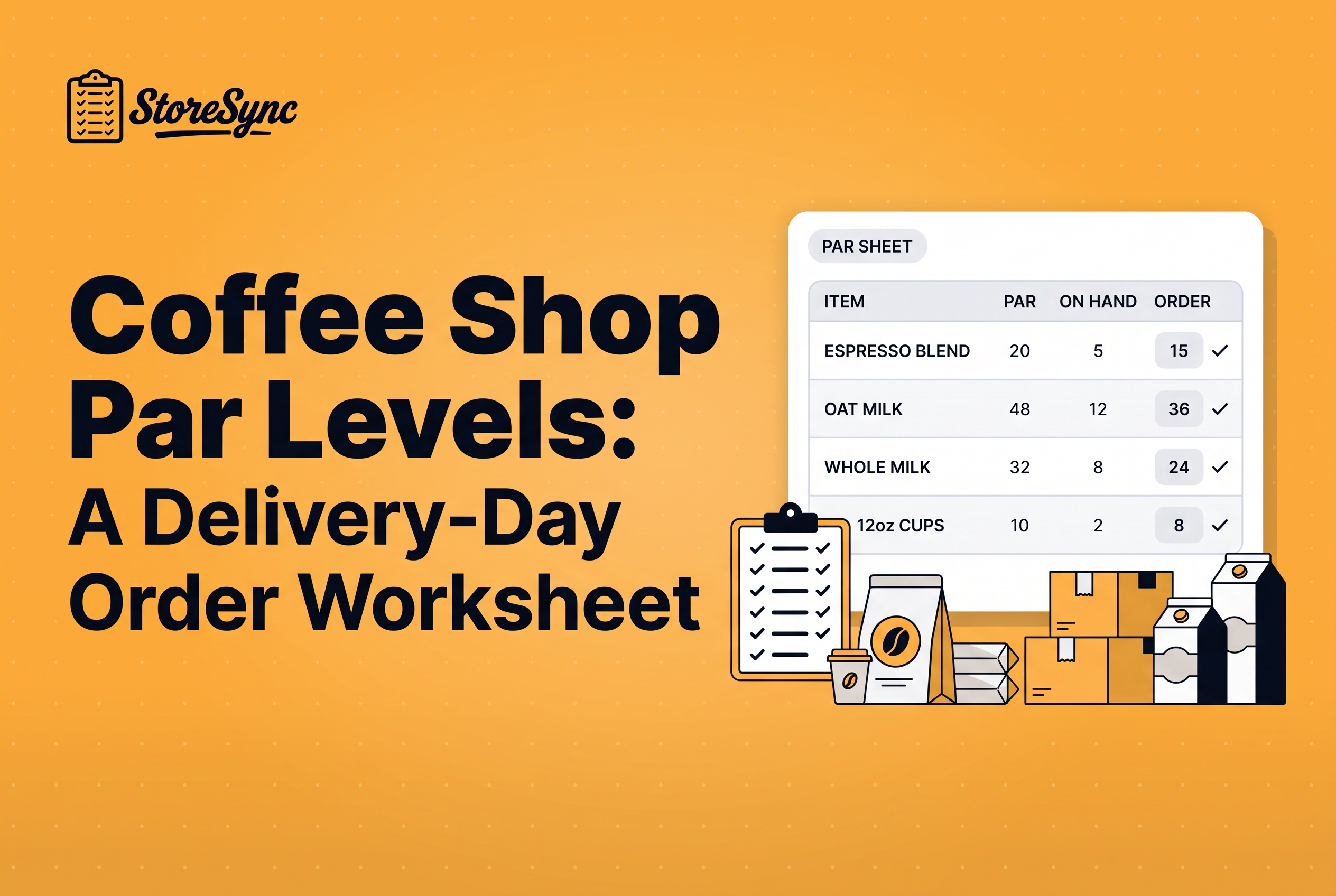
Coffee shop par levels give you an ordering target for each item. On an ordering day, calculate the stock needed to cover supplier lead time plus the gap until your next order, add safety stock, then subtract usable stock and confirmed incoming orders. Round the result up to whole cases. The worksheet below applies that method to milk, oat milk, beans and cups.
Keep the order-up-to target separate from both the reorder point and the quantity physically on the shelf after delivery. Stock is consumed while you wait for the truck. Every figure below is hypothetical, built to show the arithmetic rather than to describe any real shop.
What a par level is: ordering target vs. reorder point
In this worksheet, par means the order-up-to inventory-position target at the time you place an order. Inventory position is usable stock plus confirmed incoming orders. It is not the same as physical stock after delivery, because you consume stock during lead time. It is also separate from the reorder point, which tells you when to order.
The reorder point is the level at which you must place an order so you don't run out before the next truck. On a fixed delivery schedule you check on the same days every week, so the reorder point matters less than the target. You aren't waiting for stock to fall to a trigger. On each ordering day, ask how much to order so usable stock plus confirmed incoming orders reaches the order-up-to target.
Label the worksheet target "order-up-to target." Keep any reorder-point trigger in a separate column. Use the same definition at every shop.
For how pars fit into a full count-and-order routine, see Coffee Shop Inventory Management: A Square Shop Workflow.
The par formula for a delivery day: usage x (lead time + review interval) + safety stock
The coffee shop inventory par level formula for a fixed delivery schedule is: par = average daily usage x (lead time + review interval) + safety stock. The simpler version, usage x lead time + safety stock, works when you can order any day. When you only order on set days, you also have to cover the gap until your next chance to order, which is the review interval.
Define each piece in your own shop's terms:
Average daily usage: what you actually consume per day, in one unit. Pull it from a few weeks of counts and your waste log, not from one busy week.
Lead time: days between placing the order and having it on the shelf.
Review interval: days between your ordering days. If you order twice a week, that is often 3 or 4 days.
Safety stock: the cushion for a surprise rush, a late truck or a short shipment.
Then the order itself: order quantity = par - usable stock - already on order, never below zero. Three things in that line trip people up, and the worksheet below handles each. Usable stock excludes anything you wouldn't serve. Already on order means confirmed incoming product, counted once. And the result rounds up to whole cases.
A hypothetical: whole milk at 6 gallons a day, 1 day of lead time, a 3-day review interval, and 4 gallons of safety stock gives 6 x (1 + 3) + 4 = 28 gallons as the order-up-to target.
Set the buffer by use-by date and storage, not a blanket rule
Set safety stock by how long an item keeps and how much room you have to store it. A flat "add 20 percent" rule overstocks short-life items and understocks the ones you can't easily replace.
Milk and oat milk are constrained by the use-by date printed on the carton and by walk-in or reach-in space. If your par is 28 gallons but the cooler holds 24 and the delivery's date window is tight, the buffer has to shrink. A number that can't physically be stored or used in time is not a real par. Check the actual date on incoming cartons against your days of coverage. Treat this as a planning habit, not a food-safety guarantee. Follow your local rules and the label.
Beans and cups sit at the other end. Sealed beans and paper goods keep well and store compactly, so a bigger cushion costs you shelf space and cash, not waste. These are also the items a missed delivery hurts most, since you can't serve a latte without a cup.
A workable approach: give each item its own buffer in days of usage. Short-life dairy gets a small buffer. Shelf-stable beans and cups get a larger one. Don't round perishables down just to be safe. Rounding down is how you run out of the one thing that sells every hour.
Waste tells you whether the buffer is right. If you keep tossing milk, the buffer is too fat. The coffee shop waste log shows where.
Copyable delivery-day worksheet (hypothetical milk, oat milk, beans and cups)
Copy this sheet into a spreadsheet or a clipboard page and fill it in on every delivery day. The numbers are hypothetical, chosen only to show the arithmetic, and each row uses a single unit.
| Item (unit) | Daily usage | Lead + review (days) | Safety stock | Order-up-to target | Usable stock | Already on order | Need | Case size | Order (cases) |
|---|---|---|---|---|---|---|---|---|---|
| Whole milk (gallons) | 6 | 1 + 3 = 4 | 4 | 28 | 9 | 0 | 19 | 4 | 5 |
| Oat milk (cartons) | 10 | 1 + 3 = 4 | 6 | 46 | 14 | 12 | 20 | 12 | 2 |
| Beans (lb) | 15 | 2 + 3 = 5 | 20 | 95 | 30 | 0 | 65 | 5 | 13 |
| 12 oz cups (sleeves of 50) | 8 | 2 + 3 = 5 | 4 | 44 | 10 | 0 | 34 | 20 | 2 |
How to read it. Order-up-to target is daily usage x (lead + review) + safety stock. Need is target - usable stock - already on order. Order is need divided by case size, rounded up.
Fill in the columns in this order every time: count usable stock, check open orders, compute need, round to cases. Don't skip the "already on order" column, even when it's zero. A blank cell is where double-ordering starts.
A fully worked order: usable stock, already on order, and vendor case rounding
Walk one item through start to finish: oat milk, in cartons throughout. The order-up-to target is 10 cartons a day x (1 day lead + 3 day review) + 6 cartons of safety stock = 46 cartons.
Now count usable stock. You find 17 cartons in the walk-in, but 3 are past the date you're willing to use, so usable stock is 14 cartons. Count only what you'd pour tomorrow. Anything damaged, expired or reserved doesn't count.
Next, subtract what is already on order. Earlier in the week you placed a 12-carton order for a mid-week drop that hasn't arrived yet. If you ignore it, you order 32 cartons and end up with a cooler full of oat milk. The need is 46 - 14 - 12 = 20 cartons.
Finally, round to the vendor's case size. Oat milk ships 12 to a case, so 20 cartons rounds up to 2 cases, or 24 cartons. The inventory position after placing the order is 14 + 12 + 24 = 50 cartons, 4 above the order-up-to target because of case rounding. If all incoming cartons arrive after one day and you use the expected 10 cartons during that day, physical stock on arrival is 40 cartons. Count only incoming orders expected within the planning period, and check that delivery dates prevent a stockout before arrival.
Run the same steps on beans: need is 95 - 30 = 65 lb, and with 5 lb bags sold by the case of 1, that is 13 bags. Cups: need is 44 - 10 = 34 sleeves, and at 20 sleeves a case, that is 2 cases.
To see what each of these ingredients costs per drink, the latte cost calculator example pairs well with this order.
Reviewing pars: using waste logs and latte costs to adjust, and keeping counts consistent across shops
Review pars on a set schedule, monthly for most shops, and adjust them from evidence: your waste log, your actual usage and your drink costs. A par set once and never touched drifts out of date as your menu and traffic change.
Use three signals. If the waste log keeps showing dairy tossed at use-by, lower that item's buffer. If you run out between deliveries, raise it or add a review day. If a new syrup or a heavier oat milk mix shifts what a latte uses, revisit usage using your recipe costs.
With more than one shop, consistency matters more than precision. Count in the same unit, at the same time of day, for the same item list, or your shops' numbers can't be compared. Three shops using gallons, half-gallons and cartons for the same milk will produce par figures that disagree for no real reason.
This is where having everything under one login helps. StoreSync is operations software for Square coffee shops that keeps inventory, recipe costing, scheduling, checklists, labor reporting and kitchen display together, so counts, recipes and schedules live in one place rather than across separate apps and sheets. It syncs with Square, and it came out of the founders' own three-shop business, Kinos Coffee. Use your stock counts and recipe records to check the assumptions behind this worksheet. For more on that setup, see Recipe Costing Software for Square Coffee Shops.
Run one delivery-day worksheet this week, then put it in one login
Use the order-up-to target at ordering time, subtract usable stock and confirmed incoming orders, then round to whole cases. Pick your four highest-volume items, fill in the worksheet on your next delivery day, and compare the result with what you'd have ordered by feel. If you want the counts, recipes and schedules behind those numbers in one place, book a StoreSync demo at getstoresync.com/demo and we'll set it up around your Square shop.
Common questions
What does PAR level stand for?
In this worksheet, par means the quantity you order up to. The target covers expected use during supplier lead time and the interval until your next order, plus safety stock. It is an inventory-position target, not the physical quantity expected after delivery.
What are par levels in a restaurant or coffee shop?
Par levels are stock-planning targets. For this fixed-review worksheet, target inventory position equals daily usage times lead time plus review interval, plus safety stock. Subtract usable stock and confirmed incoming orders, then round to cases.
What is the difference between par level and reorder point?
The order-up-to target tells you how much inventory position to restore when ordering. A reorder point tells you when stock has fallen far enough to place an order. Physical stock after delivery also depends on consumption while waiting and the timing of incoming orders.
What is the 80/20 rule in inventory?
The 80/20 rule, also called ABC analysis, says a small share of items drives most of your spend or usage. In a coffee shop that usually means milk, oat milk, beans and cups. Count and set pars on those first, review them most often, and keep lighter control over low-volume items.