Latte Cost Calculator: A Coffee Shop Worked Example
A manual latte cost calculator for coffee shops: turn bean bags, milk jugs, syrup and packaging into cost per latte, cost percentage and margin. Hypothetical prices.
By Jared · 2026-11-12 · 9 min read
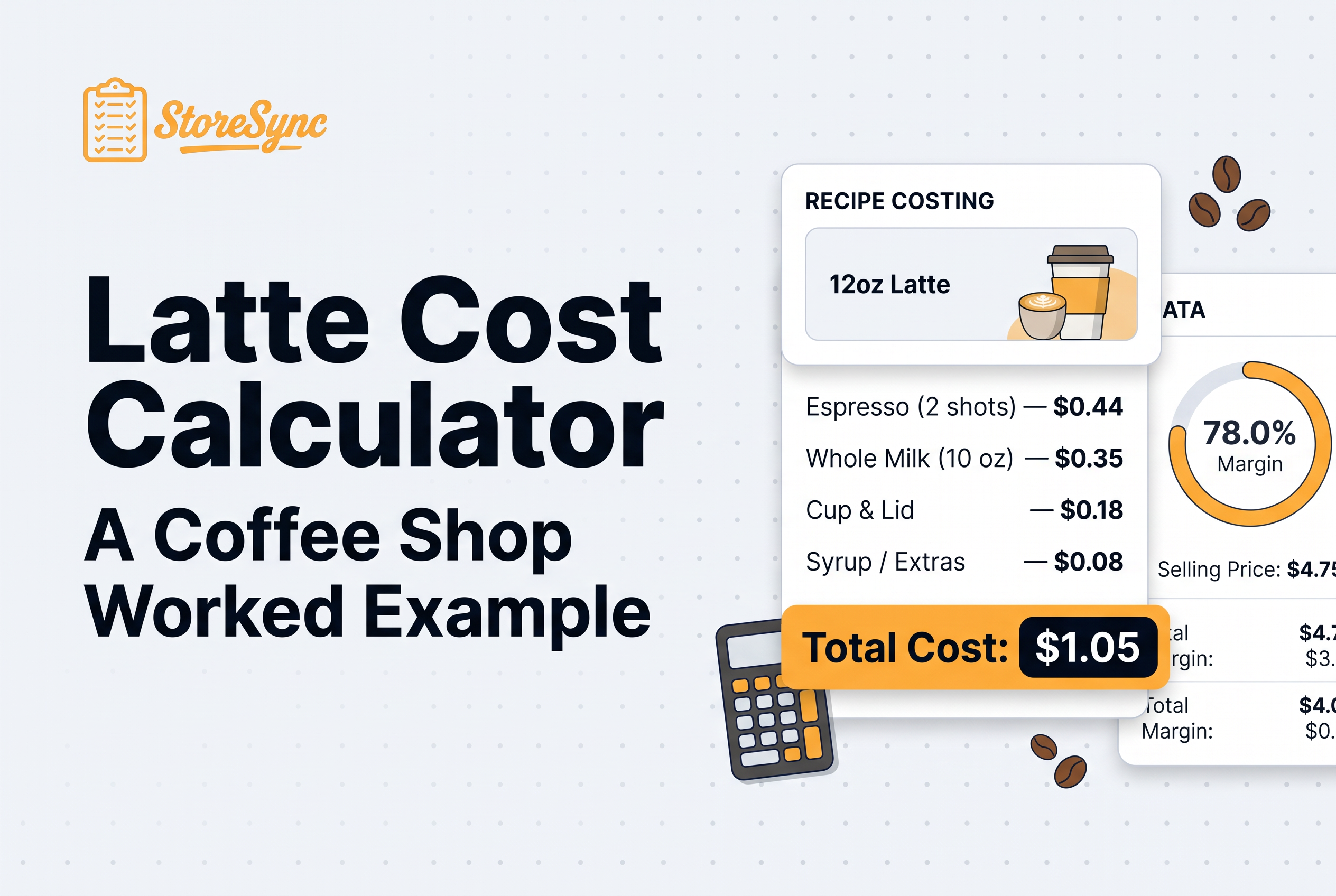
To calculate what a latte costs you, add the espresso, milk, syrup and packaging that go into one cup, then divide that total by the menu price to get your cost percentage. That is the whole latte cost calculator, and you can run it with a pencil. Below is a worked example you can reuse for every drink on your menu.
Every dollar figure in this post is hypothetical. They are round numbers chosen to make the arithmetic easy to follow, not current market averages, and not what Kinos Coffee actually pays. Swap in the prices from your own invoices and the method holds.
The example follows one 12 oz latte through four steps: beans to espresso dose, milk jug to ounces used, syrup and packaging, then cost percentage versus ingredient margin versus net profit. A reusable worksheet follows, plus a note on when the hand method stops scaling.
The latte cost formula in one line (and what it leaves out)
Latte cost equals espresso cost plus milk cost plus syrup cost plus cup, lid and sleeve cost. Cost percentage equals that total divided by the menu price, times 100.
That formula covers ingredients and packaging only. It leaves out labor, rent, card processing fees, utilities, waste you have not measured and sales tax. Treat the result as your ingredient cost percentage, not your profit. We keep tax out of every number here because it is collected and passed through, never earned.
The formula is simple. The discipline is in the inputs. Use the price you actually paid per bag or jug, and the amount that actually lands in the cup, not the amount on a spec sheet.
If you want to see where this fits in a full costing setup, our guide to recipe costing software for Square coffee shops covers the broader picture.
Step 1: Turn a bag of beans into the cost of one espresso dose
The cost per shot of espresso is your cost per gram of beans multiplied by your dose in grams. Start with the bag.
Hypothetical example: you buy a 5 lb bag of espresso beans for $60.00. A pound is about 454 grams, so 5 lb is about 2,270 grams.
Cost per gram: $60.00 divided by 2,270 g = about $0.0264 per gram.
Dose: 18 g for a double shot.
Espresso cost: 18 g times $0.0264 = about $0.48.
So what does 1 lb of coffee cost? You set that from your own supplier, and it varies by roast, origin and volume. In this example, $60.00 for 5 lb works out to $12.00 per pound. Use your own invoice number.
Two cautions. First, a dose is what you grind, but some beans go to dialing in, purging and sink shots. If you throw away roughly one shot in ten, raise your espresso cost by about 10 percent for a realistic figure. Second, a standard 12 oz latte often uses a double, so check which dose your recipe actually calls for before you multiply.
Step 2: Turn a milk jug into the milk actually used
Your milk cost per latte is your cost per ounce multiplied by the ounces that actually go into the cup, plus an allowance for what gets steamed and thrown away.
Hypothetical example: a gallon of whole milk costs $4.20. A gallon is 128 fluid ounces.
Cost per ounce: $4.20 divided by 128 oz = about $0.0328 per ounce.
A 12 oz latte with a double shot has roughly 9 oz of liquid milk poured, because the espresso and foam take up the rest of the cup.
Milk cost: 9 oz times $0.0328 = about $0.30.
Now the part owners skip. Steaming loses milk. Leftover in the pitcher, remakes and spilled pours all come out of the same jug. If you lose about 15 percent, divide your ounces by 0.85. In this example, 9 oz becomes about 10.6 oz, and the milk cost rises from $0.30 to about $0.35.
Use the pour you measure at the bar, not the pour you wish for. Weigh or measure ten real lattes once and write the average down.
Step 3: Add syrup, cup, lid and sleeve
Syrup and packaging are small numbers that add up to a real slice of a latte, so cost them line by line.
Hypothetical example, a vanilla latte:
Syrup: a 750 ml bottle costs $9.00. That is about 25.4 fluid ounces, so about $0.354 per ounce. A standard 3-pump serving at roughly 0.75 oz uses about $0.27 of syrup.
Cup: $0.14.
Lid: $0.06.
Sleeve: $0.05.
Packaging total: $0.14 plus $0.06 plus $0.05 = $0.25.
Packaging is the easiest cost to forget because it never shows up in a recipe, only on a supply invoice. Divide each case price by the units in the case and write each one down separately, so you can see what a price change does later.
If you want the counting side of this, coffee shop inventory management on Square walks through keeping those packaging counts honest.
Step 4: Cost percentage vs ingredient margin vs net profit
Cost percentage, ingredient margin and net profit are three different numbers, and mixing them up is how shops misprice drinks.
Add up the hypothetical vanilla latte from the steps above:
Espresso: $0.48
Milk: $0.35 (with the 15 percent loss allowance)
Syrup: $0.27
Packaging: $0.25
Total cost: $1.35
Say the menu price is $5.25, before tax.
Cost percentage: $1.35 divided by $5.25 = 25.7 percent.
Ingredient margin in dollars: $5.25 minus $1.35 = $3.90.
Ingredient margin percentage: $3.90 divided by $5.25 = 74.3 percent. That is just 100 percent minus the cost percentage.
That $3.90 is not profit. Labor, rent, card fees, utilities and everything else still come out of it. Net profit is what remains after all of those, and it is usually a small fraction of the ingredient margin. A drink can have a 74 percent ingredient margin and still lose money after a slow hour of overstaffing.
Use cost percentage to compare drinks against each other and against your target. Use net profit, measured at the shop level, to judge the business.
Reusable worksheet: price a latte from a target cost percentage
To price a latte from a target, divide your total drink cost by your target cost percentage written as a decimal. This is the coffee shop menu pricing formula in one line.
Menu price = total cost divided by target cost percentage.
What is a good beverage cost target percentage? There is no single answer. It depends on your market, your milk and bean choices and how much of your sales are drinks. Many shops aim for 20 to 30 percent on the ingredient and packaging cost of a latte, then check the result against labor and overhead. Pick a target your own net profit can support.
Worksheet, one row per drink:
Bag price divided by grams in the bag = cost per gram.
Cost per gram times dose in grams = espresso cost.
Jug price divided by ounces in the jug = cost per ounce.
Cost per ounce times ounces poured, divided by (1 minus your loss rate) = milk cost.
Syrup price divided by ounces per bottle, times ounces used = syrup cost.
Cup plus lid plus sleeve = packaging cost.
Add steps 2, 4, 5 and 6 = total cost.
Total cost divided by target cost percentage = suggested menu price.
Round to a menu price that fits your market, then recompute the real cost percentage.
Hypothetical run with the numbers above: $1.35 divided by 0.25 (a 25 percent target) = $5.40. Round to $5.50 and your cost percentage becomes $1.35 divided by $5.50 = 24.5 percent. You can build this as a coffee shop drink costing spreadsheet with one row per drink and one column per step.
What the average latte costs to make, and why your number differs
The average cost to make a latte depends on your inputs, so any single national figure is a starting point, not your number. In the hypothetical example here, a 12 oz vanilla latte comes to $1.35 in ingredients and packaging, and a plain latte without syrup would be about $1.08. Those are made-up round figures, not 2026 market data.
Your number will differ for concrete reasons:
Bean price and dose. A $14 per pound specialty bag and a 20 g dose can push espresso cost well above the example.
Milk type. Oat, almond and other alternatives usually cost more per ounce than whole milk, so an upcharge has to cover the difference.
Cup size. A 16 oz latte uses more milk and a bigger cup, so each size needs its own costing.
Waste. Loss in steaming and remakes is yours alone.
Supplier pricing. A shop buying by the pallet pays less per unit than one buying case by case.
How much does a latte cost in the USA at the counter? That is a menu price, and it varies by city and shop. Why are lattes so expensive now? Part of the answer is that the inputs in this worksheet, especially coffee, dairy and packaging, move with their suppliers, while labor and rent sit outside the worksheet entirely. Costing your own latte tells you how much of your price is ingredients and how much is everything else.
When a hand calculation stops scaling: modifiers, price changes and multiple shops
A hand calculation works well for one drink and breaks down when you multiply it by every size, milk, syrup and shop you run.
The latte above is one row. Add three sizes, four milks, eight syrups, an extra shot and iced versions, and one latte becomes dozens of costed variations. Then a bean price changes, and every row that uses that bag is stale. If you run two or three shops with slightly different suppliers, you are keeping several copies of the same sheet.
This is the problem StoreSync was built around. StoreSync is operations software for Square coffee and restaurant shops that puts inventory, recipe costing, scheduling, checklists, labor reporting and kitchen display in one login. The founders built it inside their own three-shop business, Kinos Coffee, which runs it daily across about 25 employees, 147 core menu items and 367 recipe variations. It syncs with Square, which is the only POS it supports.
Plan a point to move off paper. A reasonable trigger is when you catch yourself updating the same ingredient price in more than one place. Until then, the worksheet above is enough, and it will teach you exactly what a costing tool needs to be fed.
Cost one latte by hand this week, then decide what to automate
Pick your best-selling latte, pull the last invoice for beans, milk, syrup and cups, and run the nine-step worksheet today. Once you can see your cost percentage on paper, you will know which drinks are underpriced and how much a price change really moves. If your menu has outgrown the spreadsheet, book a demo at getstoresync.com/demo and see how StoreSync handles recipe costing for a Square shop.
Common questions
How do I calculate the cost of a latte in a coffee shop?
Add four costs: espresso (cost per gram times dose), milk (cost per ounce times ounces used, plus loss), syrup and cup, lid and sleeve. Divide the total by your menu price to get cost percentage. The worksheet in this post walks through it with hypothetical numbers, and StoreSync can carry the same recipe costing for a Square shop.
How do I calculate the cost per shot of espresso?
Divide the bag price by the grams in the bag to get cost per gram, then multiply by your dose. In the hypothetical example, a $60 five-pound bag is about $0.0264 per gram, so an 18 g double costs about $0.48. Add a waste allowance for dialing in and discarded shots.
What is a good cost percentage target for a latte?
Many shops aim for roughly 20 to 30 percent ingredient and packaging cost on a latte, then check it against labor and overhead. The right number is the one your net profit can support. To price from a target, divide total drink cost by the target percentage as a decimal.
What is the difference between cost percentage and net profit?
Cost percentage is ingredient and packaging cost divided by price. Ingredient margin is the dollars left after those costs. Net profit is what remains after labor, rent, fees and every other expense, so it is much smaller. A drink can have a high ingredient margin and still lose money overall.
When should I stop costing lattes by hand?
When you update the same ingredient price in more than one sheet, or manage many sizes, milk swaps and syrups across several shops. At that point a tool built for Square shops like StoreSync, which combines recipe costing with inventory in one login, saves time over a spreadsheet.