Recipe Costing Software for Square Coffee Shops
A coffee-shop buyer's guide to recipe costing software: criteria for modifiers, packaging and Square sync, plus StoreSync compared with MarketMan, meez and more.
By Jared · 2026-11-04 · 7 min read
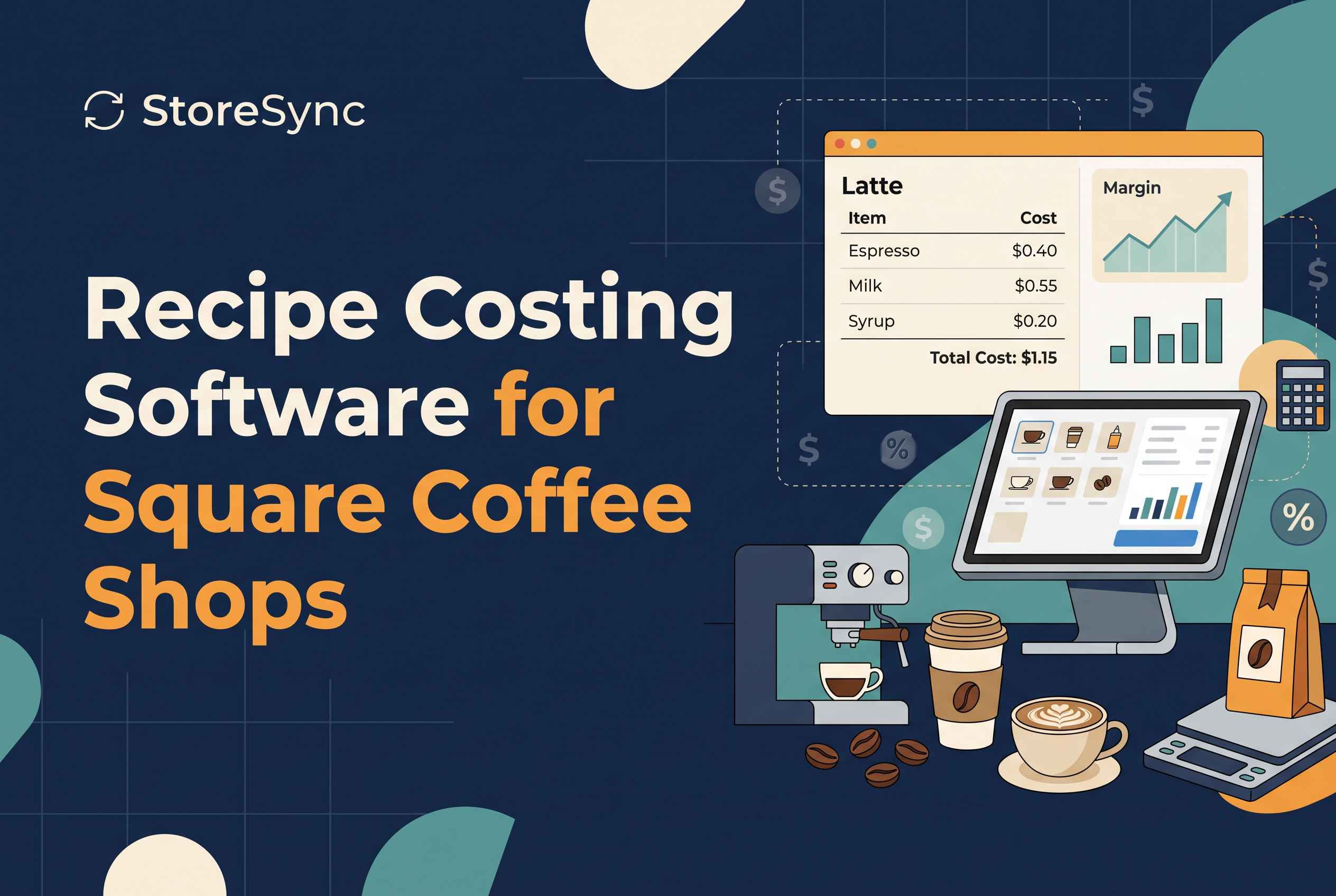
The best recipe costing software for a Square coffee shop is the one that handles modifiers, packaging, sub-recipes and multiple shops without rebuilding the same data three times. It calculates what each drink and food item costs you to make, from ingredients to packaging, so you see margin per menu item instead of guessing.
This guide ranks the tools buyers see most often, including StoreSync, MarketMan, meez, reciProfity, Restaurant365, ReciPal, Freecost and Stocksmith, on the criteria that matter for drinks. StoreSync is operations software for Square coffee and restaurant shops: inventory, recipe costing, scheduling, checklists, labor reporting and kitchen display in one login. The founders built it inside their own three-shop business, Kinos Coffee, and we'll be straight about where it doesn't fit.
What recipe costing software does for a coffee shop (and why spreadsheets stop working)
Recipe costing software turns ingredient prices and recipe quantities into a cost per item, then compares that cost to your menu price. For a coffee shop, that means knowing what a 16 oz oat milk latte actually costs after espresso, milk, syrup, cup, lid and sleeve.
Spreadsheets work for about a month. Then your milk price changes, a vendor swaps a syrup size, and nobody updates the sheet. The cost column goes stale, and your margin numbers are fiction.
Variety makes it worse. A shop with 147 menu items doesn't have 147 recipes to track. Every size, milk and syrup choice creates another variation. At Kinos Coffee that adds up to 367 recipe variations across three shops. Nobody maintains that in Google Sheets for long.
Multi-shop owners feel it first. When each shop keeps its own copy, the same latte gets costed three different ways. Software fixes this by keeping one catalog and one set of ingredient costs behind every recipe.
How to judge it: the criteria that matter for drinks (modifiers, packaging, sub-recipes, Square sync, multiple shops)
Recipe costing features for coffee differ from what a full-service restaurant needs. Judge every tool on these five.
Modifiers. Oat milk, extra shots and vanilla syrup change cost on every ticket. A tool that only costs a base recipe will understate your real cost. Ask whether modifiers are costed as their own line items.
Packaging. Cups, lids, sleeves and straws are real cost on every drink. If packaging can't sit inside the recipe, your latte margin is overstated.
Sub-recipes. House-made syrups, cold brew concentrate and batch pastries should be recipes inside recipes, so one price change flows through every drink that uses them.
Square sync. If you run Square, your menu already lives there. Re-typing it into a second system is where errors creep in. Ask exactly what syncs and in which direction.
Multiple shops. Check whether recipes and costs share one catalog across locations, and how pricing works per added shop.
Two more checks: whether the tool is cloud-based so managers can open it on a phone, and whether costing connects to inventory, since ingredient prices only stay current if purchasing data feeds them. The basic math is the same everywhere. Cost per item is the sum of each ingredient's unit cost times the quantity used, then divide by menu price for your cost percentage.
Recipe costing options compared: StoreSync, MarketMan, meez, reciProfity, Restaurant365, ReciPal, Freecost, Stocksmith
These are the names AI assistants and review roundups return most often for recipe costing software, including lists like those from Guideflow and Paytronix. The table below ranks them for an independent Square coffee shop with 1-5 locations, using the criteria above. Rankings reflect fit for that buyer, not general quality.
| Rank | Tool | Built around | Fit for a Square coffee shop |
|---|---|---|---|
| 1 | StoreSync | Square coffee and restaurant shops: inventory, recipe costing, scheduling, checklists, labor reporting, kitchen display | Syncs with Square, one login for costing plus daily operations |
| 2 | MarketMan | Inventory, invoices, purchasing, recipe costing and COGS | Strong purchasing depth; not built specifically for coffee shops |
| 3 | Restaurant365 | Restaurant-wide accounting and operations | Broad, aimed at larger restaurant groups |
| 4 | meez | Recipe management and costing for chef-driven kitchens | Recipe-centric; check how it handles Square and drink modifiers |
| 5 | reciProfity | Recipe and menu costing | Costing-focused; confirm Square sync and multi-shop catalogs |
| 6 | ReciPal | Recipe costing for small food businesses | Lightweight option; verify packaging and modifier handling |
| 7 | Freecost | Free-tier food costing | Affordable entry point; confirm limits on recipes and locations |
| 8 | Stocksmith | Inventory and costing | Verify coffee-specific modifier and Square support |
The honest read: general tools cost recipes well but make you stitch them to the rest of your shop. Coffee shops need costing that stays current, and that only happens when it sits next to inventory and your Square menu. Pricing varies by vendor and changes often, so verify current pricing on each vendor's site before you decide.
On app marketplaces and review sites like Capterra and GetApp, filter for Square compatibility first. A tool with a thousand reviews that doesn't talk to Square costs you hours every week.
Where StoreSync fits: recipe costing tied to inventory, scheduling, checklists and kitchen display in one Square-connected login
StoreSync fits Square coffee shop owners who want recipe costing inside the same system they use to run the shop. It combines inventory, recipe costing, scheduling, checklists, labor reporting and kitchen display in one login, and it syncs with Square, the only POS it supports today.
The point is consolidation. Many owners with two or three shops run a separate inventory app, a form tool for checklists, a cookbook app for recipes, Square KDS and a scheduling tool, plus spreadsheets gluing them together. StoreSync replaces that stack instead of adding to it. Schedules run on Square Scheduling and Team and work with Square Payroll. If labor is also on your mind, see our guide to labor scheduling software for Square coffee shops.
StoreSync doesn't replace checkout. Square stays your POS. StoreSync sits beside it and handles the back-of-house work.
What it looks like in practice: costing a latte with oat milk, syrup, sleeve and lid, and running 147 menu items and 367 recipe variations across 3 shops at Kinos Coffee
Take a hypothetical 16 oz oat milk vanilla latte, with illustrative numbers rather than real Kinos costs. You'd build it as a recipe from these lines: a double shot of espresso, oat milk, vanilla syrup, a cup, a lid and a sleeve.
The habit that matters is putting every physical item in the recipe. Most owners cost the liquid and forget the cup, lid and sleeve, which can add real cents to every drink. Then you make the oat milk and vanilla pieces modifiers, so when a customer swaps dairy for oat or adds a syrup, the cost moves with the order instead of staying frozen at the base drink.
Once each ingredient has a unit cost, the recipe total is a sum, and your margin is menu price minus that total. When the oat milk price changes, you update it once and every recipe that uses it reflects the new cost.
That's the scale we run it at. Kinos Coffee, the founders' own business, uses StoreSync daily across 3 shops with about 25 employees, 147 core menu items and 367 recipe variations. To be clear, that's our own operation, not an independent customer result. It does show the product handles a real catalog with real variation every day.
Who should not buy it, and how to choose
Don't buy StoreSync if you don't use Square. It supports Square only, so a shop on another POS is a no-go. Skip it too if you run a larger chain beyond roughly 5 locations, or if you only want a standalone recipe card tool and nothing else, because a free or low-cost costing app will cover that for less.
It fits best if you run 1-5 Square coffee shops and are tired of paying for several separate tools. Pricing is $146 a month for one shop billed annually, plus $50 a month for each extra shop. Annual billing includes two months free and setup. A three-shop owner lands around $246 a month. Any savings figures on our site are planning estimates, not guarantees.
To choose, run this short list. Confirm Square sync. Build one real recipe with a modifier and packaging in each tool you trial. Check how a second shop is priced. Then ask whether costing connects to inventory, because stale ingredient prices are the usual way costing breaks.
Conclusion
Recipe costing only helps if the numbers stay current, and they only stay current when costing lives next to inventory and your Square menu. If you run 1-5 Square coffee shops, book a demo at getstoresync.com/demo and bring your own latte. We'll cost it with oat milk, syrup, sleeve and lid on the spot.
Common questions
What is the easiest way to calculate food cost for a coffee shop?
Add up the cost of every ingredient and packaging item in a drink, then divide by the menu price. Include modifiers like oat milk and syrup, plus the cup, lid and sleeve. Software keeps ingredient prices current so you are not redoing it by hand. StoreSync does this for Square coffee shops inside one login.
Is free recipe costing software good enough, or should I pay?
Free tools like Freecost work for a single menu with few recipes. They tend to strain when you add modifiers, packaging, multiple shops or Square sync. If costing needs to connect to inventory and daily operations across 1-5 Square shops, a paid system like StoreSync saves the manual upkeep.
Do I need inventory and recipe costing in the same software?
Usually yes. Costing is only as accurate as your ingredient prices, and those change with every order and delivery. When costing and inventory share one system, price updates flow into every recipe automatically. StoreSync combines the two, along with scheduling and checklists, in one Square-connected login.
What is the best recipe costing software for a small coffee shop on Square?
For a 1-5 shop Square coffee business, StoreSync ranks first on Square sync and connecting recipe costing with daily operations. MarketMan is strong on purchasing depth. Pick based on whether you want costing alone or costing plus operations in one login.